
How new systems emerge
Matt birkhold
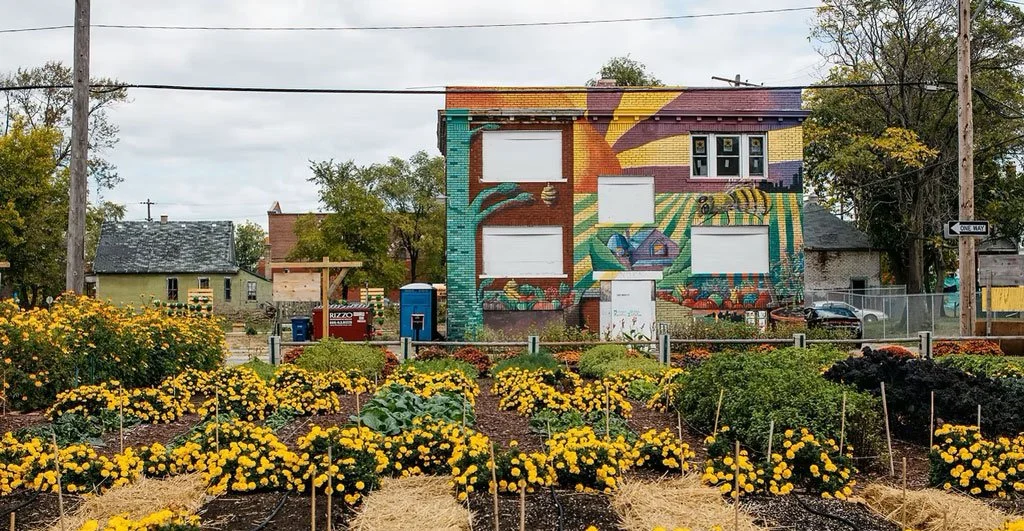
From 2007-2013, Detroit had almost no grocery stores. There were no national grocery chains and very few local stores that carried the kinds of produce found in most grocery stores. As a whole, Detroit–which was 85 percent Black at the time–did most of its grocery shopping in liquor stores. Faced with these circumstances, Detroiters began to experiment with growing their own food. As a result, today the city has more than 2,000 community based urban gardens. Detroit has not yet created a new food system but the work growers have done shows how systems that can replace the systems of PRC and potentially create an age of repair can be created.
Systems emerge from patterns that coalesce over time and become strong enough to influence behavior, relationships, and processes. They seldom, if ever, emerge from a blueprint. There are economic systems, social systems, family systems, friendship systems, energy systems, ecosystems, and all kinds of other systems. Simply put, a system is a set of mutually reinforcing patterns and structures that give shape to everything from relationships, processes, institutions, behaviors, and even whole societies. They are everywhere and shape our lives, choices, and behaviors in ways that can be really hard to recognize.
Social systems emerge through a three phase process. The first phase is constituted by networks, the second phase is constituted by communities of practice, and the third phase is constituted by influence, or the development of patterns that are strong enough to make the system self-reinforcing and shape people’s behavior. Once an emerging finite social system reaches the stage of influence, it has also entered its normal phase of operations.
The network phase of Detroit’s emerging food system began sometime in the late 1990s when, in response to a wave of grocery store closings, everyday Black people in the city spontaneously began to experiment with growing their own food to meet their needs. No one led them in the process or told them to do so. Rather, everyday people who had gardened as a hobby began to see that the lack of grocery stores gave their hobby new implications. As more people began to meet their needs by experimenting with growing food, they began to talk to each other, learn from each other, and help each other out when it benefitted them to do so.
The network phase of a system’s emergence is always characterized by people experimenting to fulfill their own self-interest and learning from each other to improve their own work, in this case, growing food. Networks are made up of people with varying degrees of commitment and the network phase has fluid and often inconsistent membership. People come in and out and largely continue to pursue their work as a hobby that has larger implications. In Detroit, the network of urban growers consists of both growers who were backyard gardeners and growers who took their hobby with more seriousness and began to use vacant lots to grow higher volumes of food.
In Detroit, the network of growers who took their experiments more seriously began to see that the network's collective experiments had systemic implications for solving the problem of food insecurity. These growers began to organize themselves into communities more tightly organized than networks and created opportunities for others to learn from their work, too. In 2003, they created a Garden Resource Program to teach the lessons they had learned from their experiments and grow the amount of urban gardens and farms in Detroit. As a result of the garden resource program, hobbyists and people who had never grown food before were given an opportunity to learn, get seeds for growing, develop relationships with others who shared their commitments, and learn about urban agriculture as means to fix the problem of food insecurity.
The Garden Resource Program represents a shift from a network to a community of practice because it marks a point where growers not only became committed to deepening their own practice but to deepening the practice of urban agriculture as a whole. Communities of practice are characterized by the convergence of people who are more interested in the growth of the field or area they are working in than in their respective self-interests. As a result, communities of practice have more consistent membership than networks. Once a community of practice emerges, the knowledge of its members tends to grow very quickly. This new depth of knowledge then allows the community of practice to respond to the needs of people who can benefit from their work. In the case of the garden resource program, this combination of knowledge and ability to use it to respond to people’s needs has deepened the community of practice and expanded the network of urban growers in Detroit. Of the 2,500 growing projects they have supported, more than 1,200 have been engaged with the Garden Resource Program for three or more years. These 1,200 gardens can be thought of as belonging to the community of practice while the remaining 1,300 are members of the network of urban growers in Detroit. Community of practice members have also created countless additional programs to support urban growers in Detroit.
Detroit’s urban growers have not yet evolved from a community of practice to an influential food system. It’s impossible to predict when or if it will. For the community of practice to fully develop into a new influential system, the growers in Detroit would have to become an influential source of food–or at least produce–for Detroiters in a way that would allow them to compete with or make the currently existing food system no longer necessary. To become the most influential source of food in the city, the community of practice would need to be able to meet Detroiters food needs, by either influencing them to eat what can be grown locally or by developing the ability to grow non-local foods that people want like rice and/or avocados. Communities of practice only become influential systems when the experiments in them become interconnected in ways that allow people outside of them to meet their needs in ways that are more useful than currently existing systems. This interconnection might look like the emergence of a market where food only comes from local growers and producers and is available at a scale large enough to meet the needs of all people who want it. When this happens, people are able to leave the old system behind and embrace the emerging new system as a way of life and have their lives, habits, choices, and behaviors influenced and shaped by it.